Predicting from a small table
Kumo Tabular is a model NVIDIA trained on many tables. It reads the rows whose outcome you know as examples and predicts the rest, without training on your data first. It runs on your computer's processor, and it is an optional download, together with gbnet, which fits LightGBM models for survival and ordered outcomes, and Polars, for data frames beside pandas.
Follow along: download tabular-model.ipynb (4 KB) and put it in a project folder.
1. Download it
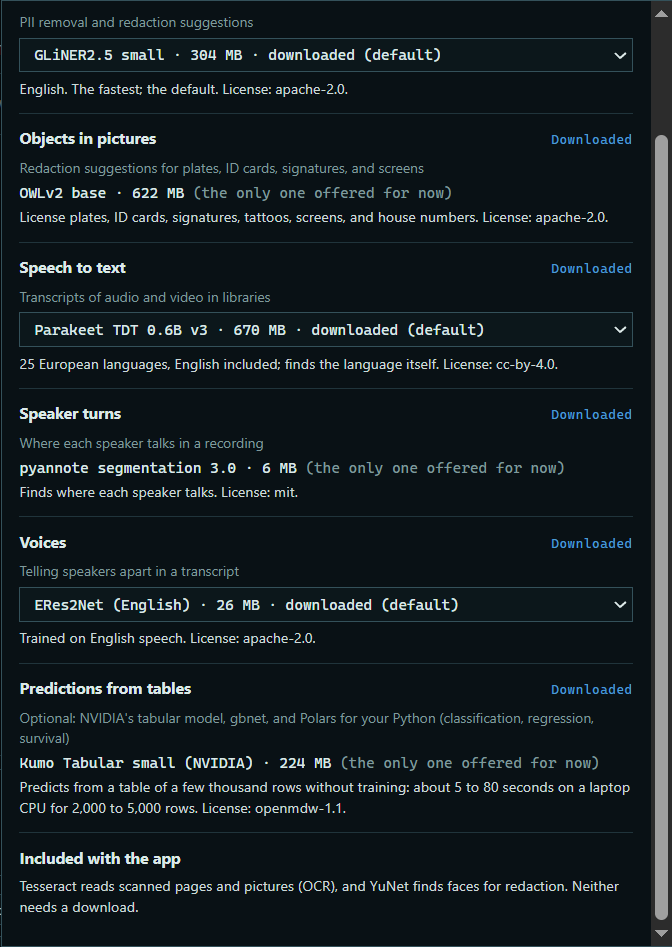
Press Local models and find Predictions from tables, then press Download. It adds about 180 MB of Python libraries (Torch, NVIDIA's package, gbnet, and Polars) and the 224 MB model, and every file is checked against the app's pinned hashes.
 Expand
2. Run a notebook
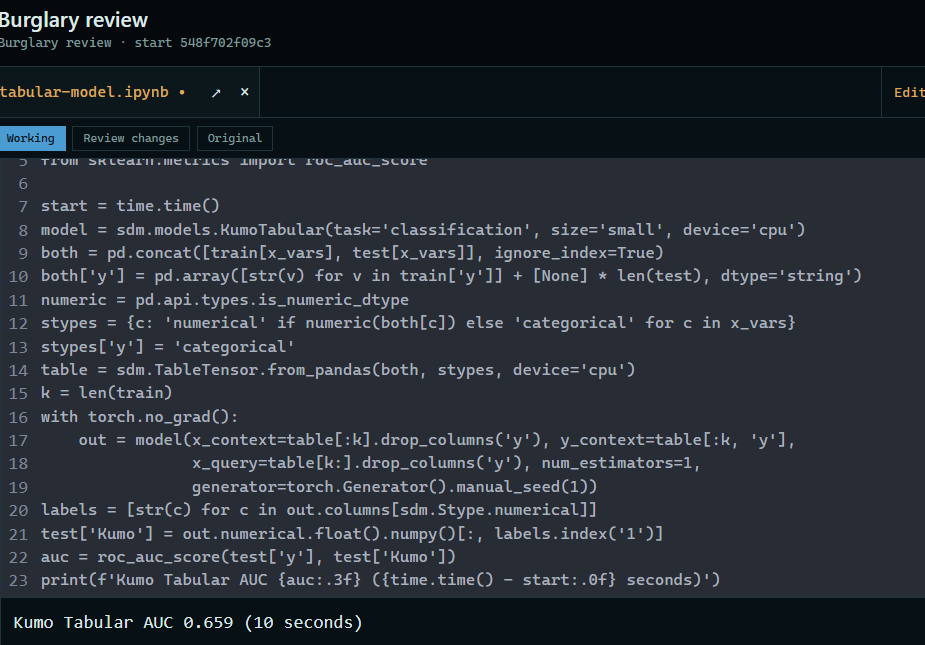
Open a notebook that uses it and press Run all. Here, 2,000 made-up people to learn from and 1,000 to predict: it took seconds, not minutes, most of it loading the model.
 Expand
3. Compare it
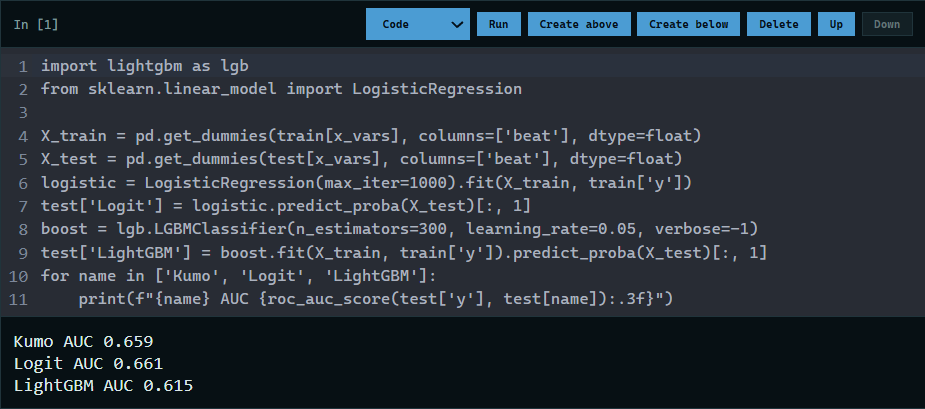
Fit the usual models on the same people. On this made-up data, logistic regression did about as well, which is why it is worth fitting every time.
 Expand
Good to know
- It works best with a few hundred to a few thousand rows to learn from. Time grows with the rows: on a laptop, about 5 seconds for 2,000 rows, and over a minute for 5,000 rows with eight estimators. Past about 10,000 rows, use LightGBM.
- The machine learning skill shows the assistant how to use it, and gbnet's survival and ordinal models, in a project with Assistant-run Python on.
- Its weights are published only as PyTorch .pt files. The app accepts that format for this model alone, pinned to NVIDIA's exact files, and only NVIDIA's package loads them, with PyTorch's safe loader, inside the sandbox.
- Licenses: OpenMDW for the model's weights, Apache-2.0 for NVIDIA's package, and MIT for gbnet.